
Saying Goodbye to Ginger
Our beautiful story of love, healing and letting go

This is the story of how my best friend Ginger the Dog left this life. I understand, this one might not be for everyone. In the days before my life was marked by the loss of so many loves, I remember standing in the books aisle at Target pretty much sobbing over the last picture ever taken of Marley in Marley & Me. So if pet death isn’t something you want to read about, or you’re just not in a place for it right now, believe me, I get it.
But if you are up for it, this is one of the most beautiful stories I have to tell. Ginger left this life with so much love and grace, and as she did, she taught me so many indescribably wonderful things — about life … about me … about everything. Here then is my attempt to honor her life and her death by sharing this part of her story with you now.
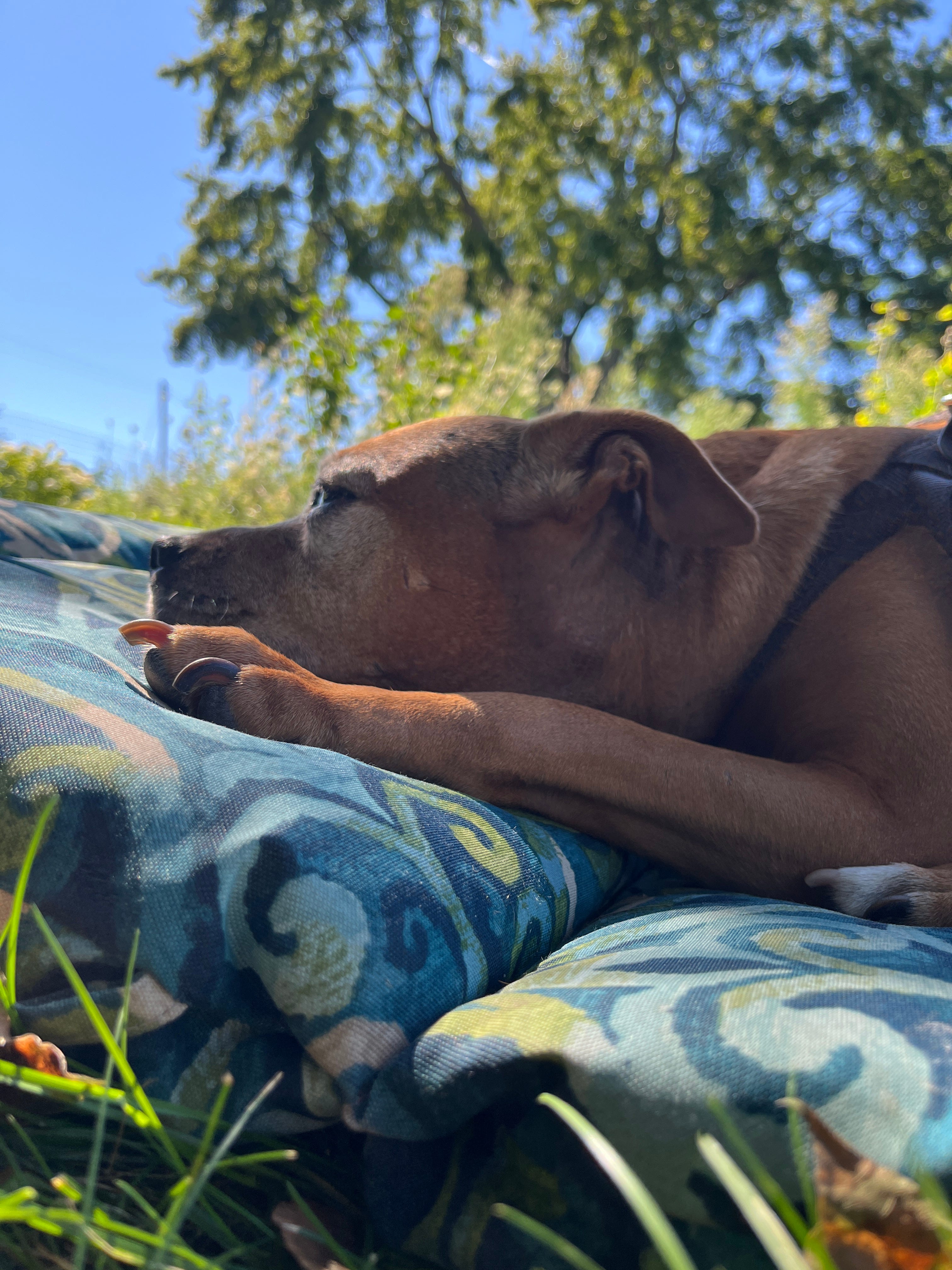
Hello Friends,
I’ve put this off for five months, which is funny because I can’t stop telling this story to anyone who will listen in person or over the phone. But as the months have stretched on, I found that I wanted my relating it to you here, in writing, to be something profound — something that would do justice to Her and everything She was (and still is). That’s the trouble with writing sometimes. The important things feel too important, and then I get in my own way. So I’ll just tell you, the same way I would tell you if we were, say, standing on a path together in a village in Northern Scotland (which is actually one of the many places I have told this story in the last five months).
Ginger left on the last day of August in 2025. She had cancer, and had had cancer for quite awhile at that point. I’d first found the tumor in her neck in January of 2024, it had been removed in April that same year, and by May the surgeon confirmed his worst suspicion: Ginger had thyroid cancer, which is particularly aggressive and almost always terminal in dogs.
“Most dogs with this cancer aren’t still with us in a year,” he told us, gently, when he delivered the news. Chemotherapy could have, possibly, if she responded well to it, extended her life two, maybe three, years. But that would have meant nearly constant doctor’s appointments for the year after her diagnosis, and our girl hated nothing more than going to the vet. We knew that if we asked that of her, her anxiety would increase a millionfold while her quality of life diminished rapidly. We couldn’t do that to her, and her doctor, having met her a time or two, agreed.
She did really well though! She lived so much longer than “most dogs with this cancer,” which I think is a testament to her strength, her resilience and her will to keep living a life in which she was very, very happy.
But it did eventually catch up with her, no matter how much we hoped it wouldn’t. I first noticed a change during the week of the Fourth of July — a holiday here in the States that is particularly obnoxious for anyone who doesn’t love the constant sound of explosions, and is especially devastating to people and animals who have trauma around these kinds of noises. Ginger definitely fell into this category, and by the end of that week, we were sleep deprived and our nervous systems were fried.
I thought that was it. Or I hoped it was. But in looking back, I think the stress hormones that flooded her system that whole week upset her balance so much that she was no longer able to keep up the fight.
I didn’t know that yet, though. It was still the end of that noisy week, and we were at the Little Lake parking lot one morning (one of her very favorite places), and it was getting hotter and more humid by the moment. We were headed back to our truck when she suddenly couldn’t walk forward anymore. Our destination was still all the way across the parking lot, and I wasn’t sure how she’d react when I picked her up, but I knew it was our only chance to get home. She was a bit tense and snappy immediately, but as soon as I had her secure against my chest, and told she was safe and ok, and I had her, her trust in me kicked in and she relaxed her whole body and let me carry her back to the truck.
“Do you think this was the hot and humid day, or do you think this is the progression of her illness?” her regular veterinarian asked over a telehealth appointment later that day. I hoped it was just the weather, which was pretty awful. But it turned out Ginger was getting ready to leave … and the two months that followed were really hard, but so incredibly beautiful, too.
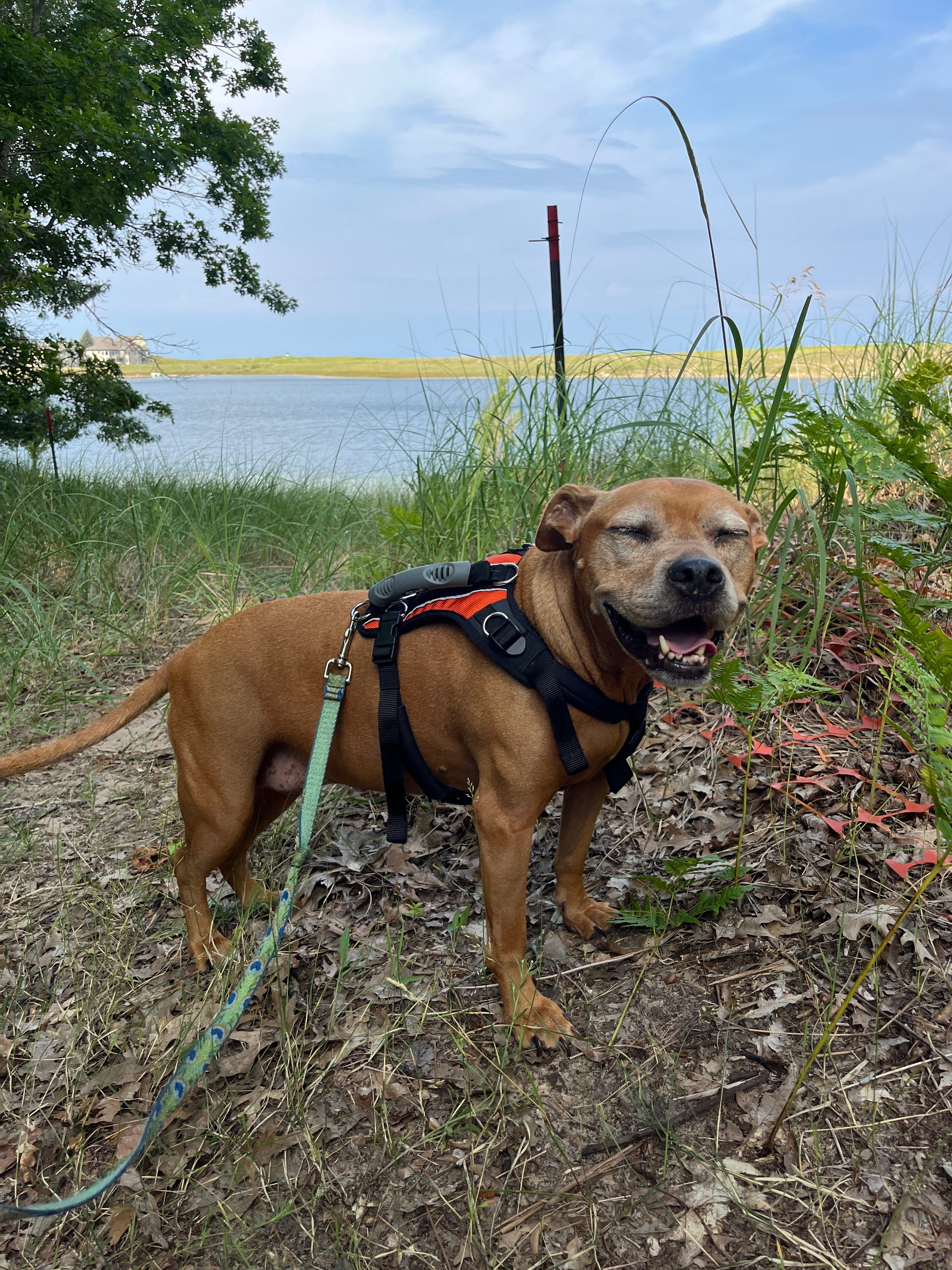
Taking care of someone’s body while they do all the things they need to do before dying is such a profound honor.
This was actually the eighth time in nine years I’d had that honor, and as I held space for Ginge, she held space for me to process all the grief from all those other loves, who died in such quick succession from 2016 to 2020 that I never really had time to deal with my actual feelings as they left.
I thought I had, by the way. Grieved and felt it all. So much so I even wrote a book about all the amazing things I learned about death, and how beautiful it is. Nothing about the book is untrue or inauthentic. I did learn all those things. And all my previous practice made me great while dealing with Ginger’s illness, barely shedding a tear as her doctors explained things to me, as I asked them informed questions, and as we discussed options along the way. But as I told the people who loved Ginger as much as Mom and I did — in particular my brother Ponch, who also belonged to Her and had lived with us for many of the years Ginge was with us — I found I couldn’t do it without sobbing.
“It’s all of them,” Ponch pointed out, and I knew the truth of it as he said it. I was grieving them all, and Ginger was helping me do it.
The weeks progressed, and Ginger lost more and more functionality. By the last two weeks, she couldn’t use her back legs, and she lived in the Help ‘em Up Harness we’d bought when she’d had leg surgery two years before. I would hoist her back end up using the handle on the harness, and she would trot around on her front legs, assuring me she didn’t mind. That she was still eager to go. That she still wanted to be alive.
Of the seven who went before, four of them were animal friends. And all of them died without veterinary intervention, which I realize now is pretty uncommon. But part of what made that possible is that they weren’t in pain. They just slipped away one day at a time over the course of a week or so.
Ginger was stoic, but it was clear she was in pain, and she required pain medication, in increasing doses, as the cancer progressed over the last months of her life. When the other animal friends couldn’t eat anymore, it was ok. They didn’t have to. But I was pretty sure it wouldn’t be the same for Ginge. She couldn’t stop eating, because food was how I got her to take the meds that kept her comfortable, and food was what ensured those meds wouldn’t tear her digestive system apart.
The tumor in her neck had come back after it was removed, but it grew slowly over the last year. And then, during that last couple weeks, it rapidly expanded from the size of an egg to the size of my entire hand. As it got bigger, it seemed like eating got a little more complicated for Ginge, so I started to hand feed her, which neither one of us minded. It reminded me of Aunt Roe, actually, who also had to be fed in the last weeks of her life.
“You’re very good at this,” she told me once, and Ginger seemed to agree.
So we kept going like that, but in the last week, I could tell our girl, who was HIGHLY food motivated, was losing her desire to eat. I knew what this looked like because I’d seen it so many times before. It happened to my dad. It happened to Uncle Don, and Aunt Roe. It happened to Little Dog, Mouse and Beece.
And so I knew we were getting close, and I knew I needed some more information. I booked a consultation to talk with Ginger’s doctor, who I’ve known pretty well over the years. We met back in 2009 when I wrote a story for the newspaper I worked for about a rescue dog who had to have her leg amputated, and I appreciated this doctor and her approach to treating animals so much that I immediately placed my five friends in her care. A few years later, when I left the newspaper and was giving a freelance writing career a shot, I supplemented my income by working in the boarding kennels that were a part of her practice. She knows me, and knows the love and care I give to all animals, and especially those who have chosen to share their lives with me.
“What happens when she can’t eat?” I asked her. “Are there liquid options to keep her pain under control?”
We talked about compounded medications, how much I could give her, what the most important components were to keeping her comfortable, and what I could give her in liquid form.
And then, the doctor was very gentle as she asked, “Do you think it’s time?”
That day, it wasn’t. It was Wednesday, and Ginger was still telling me that she was trying. I showed the doctor pictures of her playing games with me earlier that day, told her about how Ginger was chatting at me, instructing me to put more treats in her snuffle mat. She wasn’t ready yet, but I knew we were close. I told the doctor that, and also shared with her how important it felt to follow Ginger’s lead on this, especially given how much of her life had been ruled and dominated by others. Giving her the chance to do this on her own, if that’s what she wanted, felt important.
“I trust you,” she said, which meant the world to me.
Because here’s the thing: I was in the midst of the deep and heart-wrenching process of learning to trust myself. Not to be perfect, but to make the best decisions I possibly could with all the information I had. And recognizing that sometimes those decisions don’t work out the way we hope they will, but that we still do the best we can.
Here’s an example: at one point in that last couple months, I raised a concern with the doctor about how dopey one of the pain medications was making Ginge, so we tried a different one. The new medication had terrible, terrible side effects for her, making her so anxious she cried for two hours after we gave it to her.
Sometimes, as a psychic, I feel like I should know these things. Be able to access perfect information so that I can prevent all suffering or make only the right decisions. But it actually doesn’t work like that — at least not for me. And part of what Ginger was showing me was that there are no right or wrong decisions, and the more I can let go of the idea that I have to be perfect at all times and in all things, the more peace I’ll find within.
This lesson crystalized into perfect clarity in Ginger’s last days, but it was excruciating as I learned it.
During that final consultation, the doctor and I talked about an at-home euthanasia doctor who serves our area. “Give her a call,” Ginger’s doctor said. “Find out how it works, so you’re ready.”
And I did. The next day, a Thursday, I called the service and later that evening, the at-home doctor’s assistant called me back. She explained to me what it’s like: the doctor comes out, administers the sedative shot and then gives us all as much time as we need together. Once we’re all ready, she would administer the final shot, which painlessly stops the heart. All this while, we’re in our home. Our girl is in her safe space, her favorite spot. Comfortable. Loved. Not afraid.
Typically this would happen within two to three days of letting them know, but on very rare occasions, they could come out the same day.
“Are you ready to schedule?” the assistant asked me.
That evening, we still weren’t. We hadn’t gotten that signal from Ginge, telling us she was ready. But I got off the phone and related everything I’d heard to Mom. Ginger listened attentively as we talked, and we all agreed that, when it was time, this sounded like the best way for her to go.
It turned out that Ginger agreed more than we realized.
Ginge and I didn’t sleep a lot that last week. We’d moved my bed downstairs to the dining room, something we’d done before during various illnesses and recoveries. But Ginger mostly wanted to lay on one of the two loveseats in the living room. To be close to her, I slept on the other one, which was positioned at a right angle next to hers, but there were a lot of times during the last few nights when Ginge wanted me even closer than that. We’d pushed Ginger’s little dog couch up to her loveseat to use as a step up once jumping became impossible, so sometimes I slept on her little dog couch, and sometimes I just slept on the floor next to her. Occasionally, she’d want to go into the dining room and sleep on my bed, so I’d sleep on the floor next to her there. We were awake a lot in the middle of those nights, and as you can probably imagine, the quality of my sleep wasn’t great.
That night, after talking about the at-home doctor, during one of our many times of being awake together in the middle of the night, she let me know she was ready. When Mom woke up the next morning, I asked what she thought, she looked at Ginge and could see what I had seen, too. Our girl was ready to go.
So this was Friday morning, and I called the at-home doctor’s answering service and left a message, telling them the shift had happened overnight, and we were ready to schedule.
Once she decided she was ready to go, things changed quickly. Ginger spent Friday really peacefully, and we spent a lot of time on our back porch with her sniffing the air. But she was having a hard time going to the bathroom, and by Saturday, this had gotten a lot worse. It was obvious Saturday she needed help soon, but she was still super peaceful, and spent a lot of time out in the backyard, going around and napping in several different spots she loved. One of her favorite friends, a neighbor whose yard backs up to ours, climbed over the fence to spend time with her that day, and she was so happy, surrounded by so much love.
By that evening, I knew I needed to check in with the at-home doctor, because I still hadn’t heard back. I left another message, letting them know that things were progressing quickly, and asked if they had any idea when they could come out. The assistant called me back just before 9 p.m. and told me the doctor wouldn’t be available until Sept. 8. It was Aug. 30. There was no way Ginger could wait that long.
I was in a panic, because I had promised our girl this peaceful death. The one at home — safe, comfortable, without fear. And now I was breaking this sacred promise. But all the while, I was being directed within, into deeper trust. I was hearing from my inner guidance that it would all work out. That it would all be ok.
We sat down with Ginger and explained what had happened. That what we promised couldn’t be, and that we had a couple of options. It was Saturday of Labor Day weekend, so the many people who loved her at her regular doctor’s office wouldn’t be available again until Tuesday. “But you’ll have to go to the bathroom before then, if you want to wait,” I told her. The other option was to travel to one of the emergency hospitals, which were an hour and a half or two hours away, depending on which direction we headed.
I was scared. Going to a hospital where she didn’t know anyone, where she wasn’t already beloved by so many, seemed like an awful way to leave this life for a dog who got so very anxious when anything to do with doctors was involved. But I kept getting the message to trust her and to trust the process.
“It will all work out,” my inner guidance continued saying.
We went to bed with Ginger considering her options, but before we could fall asleep, Ginge got restless.
As Mom and I gathered around her and fretted together, our dog started to howl out a soul song.
During that last couple months, as we’d worked to get her pain medications just right, Ginge did experience a couple episodes of breakthrough pain. They were horrible, heart-wrenching times during which she cried and panted and shivered while we all waited for the meds to kick in. Each time, I would ask her if this was it, if she needed help, if she was ready to leave. And she would assure me that it was not time, and that she’d let me know when it was.
That last night, and the howling soul song was nothing like those times. Even still, we were afraid she was suffering, so I did give her the additional dose of her pain medication that was within what the doctor had approved. But this seemed different somehow. Not like those previous episodes of pain.
“It sounds like she’s singing,” I said to Mom, and we both agreed, this was something else.
Whatever it was, Ginge was telling us clearly, she couldn’t wait until Tuesday. She was ready to go, and the sooner the better. We were relieved on a lot of levels when she stopped singing and laid down to go to sleep, not the least because we had a long drive ahead of us and it was very late at night. Mom has cataracts, which makes night driving less than ideal, and I was operating on only about an hour or so of sleep the night before.
We both went to bed with our fingers crossed, hopeful that last dose of medication had made the difference Ginge needed. But a couple hours later, she woke up again. And again, she started singing. Her songs woke Mom up too, and together the three of us sat there while Ginger howled to us.
Again, this seemed so different and, as she sang to us, I realized why.
This girl had been through so much in this life. Illness, pain, sorrow, and trauma. So. Much. Trauma. And I think her Soul Song was a final release, of all of those things. She didn’t want to carry any bit of that into what was next, so she let it all go, in howls that were heart-wrenching for us, but absolutely liberating for her.
It became clear we were right, it wasn’t pain, because without the aid of any more medication, she finished singing, settled in on my bed and went back to sleep. For hours. And then, on schedule for her next dose, she woke up and ate enough food to take her meds.
And I started making calls.
Sometime while I slept, the solution to our problem presented itself to me. The way to give her the peaceful death we’d promised. The one without fear.
Ginger’s favorite place was at home, but her second-favorite place was the truck. The backseat area is big enough with the seats pushed up to fit her dog couch, and we’d spent many happy hours together driving along with her on her couch, her head resting on the armrest between us. I just needed to find a doctor willing to administer the euthanasia in the truck.
After a few calls around, I did. The hospital an hour and a half away would gladly do this for her, and the receptionist even checked with the doctor on duty that morning to be sure. Ginger was still resting comfortably, no more complaints and no further songs. When Mom woke up, I asked what she thought of this new plan, and she agreed it sounded great.
As we got ready, Ginger got up and wanted to sit in a chair looking out the window where she loved to watch the birds. She was still sitting there when I brought over the tranquilizer, which she always needed for vet appointments. But she looked at me in a way that told me it wouldn’t be necessary.
“No, Jode,” she seemed to say. “I don’t even need that anymore.”
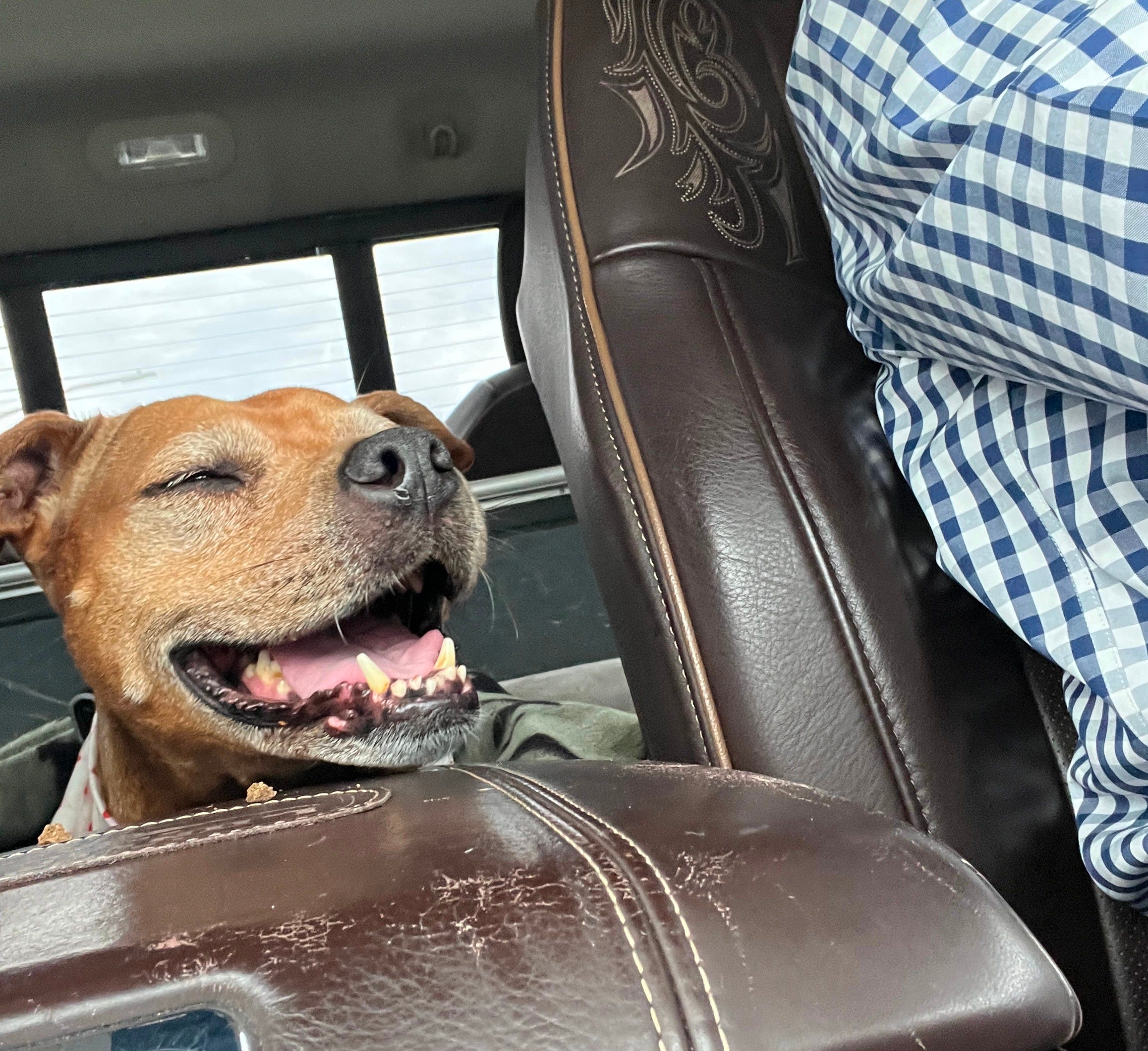
We got into the truck and she settled happily on her little couch. Typically, she would’ve insisted we needed her to be our assistant driver, a job she took very seriously. Even driving home from past surgeries, she refused to fall asleep. “It’s super dangerous to sleep while you’re driving,” she would say, and we certainly couldn’t argue with that. But that last drive, she left it to Mom. “She’s got this,” was her mood, and I think she was kind of making sure that it was true before she left. It had been a really long time since Mom had driven without her expert assistant.
Sunday of Labor Day weekend at the regional emergency hospital for a very large, very rural area … was busy. We parked in the loading area behind the hospital because we couldn’t find an open parking spot.
Our vet tech came out — an angel called Autumn, who had a kind of fairy quality to her face and sported two big buns on the sides of the top of her head, with a fall of wavy hair down her back. She was that perfect blend of cheerful and solemn that I’ve found regular attendants of death can often pull off. She knew how hard this was, and also how beautiful. She told us we could stay parked in the loading zone, and that this might take a long time.
We didn’t mind the wait. The three hours we spent with Ginger in the hospital parking lot were truly lovely. We talked about how amazing she was, and how brave. She had a couple of peanut butter licky pads, and she smiled while we talked about how amazing life would be when she comes back as a puppy (something we’d all promised each other along the way).
When the angel Autumn came out to administer the first sedative shot in Ginger’s rear, Ginger was so happy and grateful she pushed herself up with her front legs so she could turn around and KISS AUTUMN’S FACE! THREE TIMES!
I’ve never seen anything so beautiful in my entire life. Ginger was not a dog who bestowed that kind of affection on people she didn’t know, but it was clear she was so happy and grateful, and she wanted Autumn to feel all the love that was in her heart. Autumn’s delight at being showered with kisses was obvious, making us think this probably isn’t the response she’s used to!
After the shot, Ginge sat with us, smiling and content and so, so peaceful for a bunch of minutes before she laid down and went to sleep.
We were pretty confident she was entirely sedated when Autumn came back out to put in the IV line, through which they would administer the final medications. But when she tried to shave Gingy’s leg with a buzzy little razor, our girl woke up and said, “No, ma’am! You will not shave my leg with that!”
“I’ll give her a little more time,” Autumn said, not offended in the least. A while later, when she came out again, she started the buzzy razor and put it next to Ginger’s paw, testing the waters.
“No ma’am!” Ginger said again. “I’m going to need more drugs for that!”
“Does she hate having her nails cut?” Autumn asked us, and we confirmed that, yes, nails are in fact a whole entire thing. “This is super common with dogs who hate having their nails cut. They smell me, I smell like the vet, and then I’m coming at their paws with this thing and they do NOT want me to touch their paws. I can give her a little more of the sedative to set her at ease.”
I was worried about this, thinking maybe the story I was telling myself about the perfect peace and ease our dog was experiencing was wrong. But when I looked at her, and felt her energy, she was so clearly perfectly peaceful and at ease. It wasn’t a story, it was the truth. As we waited for Autumn to come out with that second dose, it became clear that this was, for Ginger, a part of her perfect, beautiful death. Asking for more medication before proceeding to the final shot was an act of bodily autonomy for a being whose sovereignty had been brutally stripped from her in her early life. And I was proud of her! This dog had HEALED, and she was ready to go out — but only on her own terms.
Ginger got her extra meds, and when Autumn brought the buzzy little razor out for a third time, Ginge didn’t mind at all.
She was so peaceful when the doctor came out — another angel with such a kind, sweet face and something in his essence that made it clear that he felt what he did, like it was a holy sacrament. It was time for the final shot, and after he administered it, he said, “go and meet your maker, Ginger,” and continued to murmur other comforting words over her in a soft, gentle voice as he watched her leave, finally checking with his stethoscope and confirming that her heart had indeed stopped.
“We’ll come back as soon as we can,” he said, but apologized because they were so busy and it would be another wait. We didn’t mind, though. It gave us the chance to sit with our friend while she finished pulling all her energies out of that body.
It’s been interesting for me to observe how different beings do this in different ways. When Mouse, one of my cat friends, died my inner guidance told me to keep petting him after his heart stopped, that by stroking his body, I was helping him leave completely. And after about 30 minutes, I felt when he’d finished the process. A few months before that, when my other cat friend Beece died, it was Mouse who did this for him. Beece was lying on my chest, and I had my hand under his body, feeling as his heartbeat changed and slowed. Mouse was down by my feet, but he got up, crossed my body so he was on the side of Beece’s face, leaned his head down and licked Beece’s paw as Beece’s heart beat for the last time. And that was all the help Beece needed to be completely done.
With Ginger, I knew she didn’t really need my help. She’d done so much work — over years, not just months or days — and her Soul Song had been her way of completely letting go. But I stood where the doctor had been, with the backdoor of the truck open, so I could see the look of absolute peace on her face, and I stroked her body knowing that she didn’t need my help anymore, but that I could still give it, a little bit, one last time.
After a few minutes, I could feel that she was done, and so I went to the other side of the truck where I could sit in the shade while we waited. Ginger was lying on her couch, with her face in the sun when the doctor and another person came out with the stretcher. When the doctor opened that side of the truck and saw her lying there, he said, in awe, “Oh Ginger, you’re beautiful. The light!”
I don’t think the angel doctor was talking about the sunlight. Something about him — everything about him that we saw and experienced in those few profound minutes that we spent with him — made me believe he was seeing more than the sunlight. He was seeing Ginger’s Light. The beauty of Her. Because she was glowing and shining.
They took her body, and we got ready to drive home. It’s the weirdest thing in the world, to watch as they wheel away the body of someone you love so much. To drive away from the last place you were physically together. But it has to happen. Life has to go on.
Before we left, though, I checked on Ginger’s energy.
When she was a very young dog, when she’d only been with us for a short time, she would do this adorable and hilarious thing. She’d jump up in the air — all four paws, simultaneously, straight up off the ground. It had been a very long time since she’d done this, and I’d almost forgotten it. Until I got her energy. She was doing exactly that — springing up in the air, over and over and over again. It was so cute and so funny, just as it had been all those years before, and I laughed out loud.
She was buoyant. Exuberant. Free.
It was hard to be sad when she was clearly so, so happy.
But I’ve managed to be sad. I can’t tell you how many Kleenex I’ve gone through typing this today. I’m not wondering anymore why it’s taken me five months to write it. I remember now. I didn’t want to cry this much.
No matter how many times we do this, or what gifts we might have when it comes to helping others die, it’s hard and it hurts when they leave. We miss them. We ache for the closeness we shared with their physical bodies, even while they assure us they’re still close by. Even as they ask us, “What are you so sad for? I’m right here.”
It’s such a beautiful reassurance, when I get the energy of the dead. They almost seem baffled at our sadness, as if they forget instantly, as soon as they pass, the pain and heartache that is such a huge part of being alive.
Isn’t that kind of wonderful?
And animals are especially remarkable because they don’t even seem to have the same attachment to their mortality that we humans do. They still fight to stay with us for as long as they can. For us, for their own healing, because they love their lives. But when it’s time to go, they go happily and easily and peacefully. And they surround us completely in that incredibly unconditional love they have for us. And they continue to remain in our hearts for the rest of our lives.
On that path in Scotland, a couple months after Ginger died, I made friends with a stranger for a few minutes as I told him all about my dog. The stranger/friend told me a story, too. His mother had been at the end of her life, and was really quite scared to die. One day, they came in to find her beaming with happiness. “What changed?” they asked, and she said she’d had a dream the night before, and in the dream every animal she’d ever loved came to her, gave her a cuddle, and told her it was all going to be ok, not to be scared anymore. And she wasn’t. She was at peace.
We cried together on the path, this stranger/friend and I, at the marvelous miraculousness of our animal friends and their love, and of the beauty of death. What a remarkable thing it is when a being finishes their life here, and becomes whatever is next.
Ginger taught me so many things in our eight years together, helped me heal so many deep wounds from my own puppyhood, showed me so much about unconditional love, became my definition of resilience, and redefined what I understand about love and healing and friendship and life. She survived so much, and blossomed in spite of (or maybe because of?) it all. And she made me realize that, if she can do it, maybe I can too.
Friends, if you’ve made it to the end of this, thank you for sharing this space with me, and with Ginge. She was and is such a special being, and we both hope her story — our story — has helped you, moved you, and maybe even contributed to whatever healing you’re experiencing now. Ginger, and how she lived and healed, showed me that we not only survive our trauma, but we thrive and heal, too. Even if sometimes that healing takes an entire lifetime to fully unfold. And she showed me that the ways we have survived are sometimes the gateway to how we thrive, because, as much as we wish they had never had to exist, those parts of us are the deepest and most beautifully compassionate parts we have.
With Love,
Jodie (and Ginge)
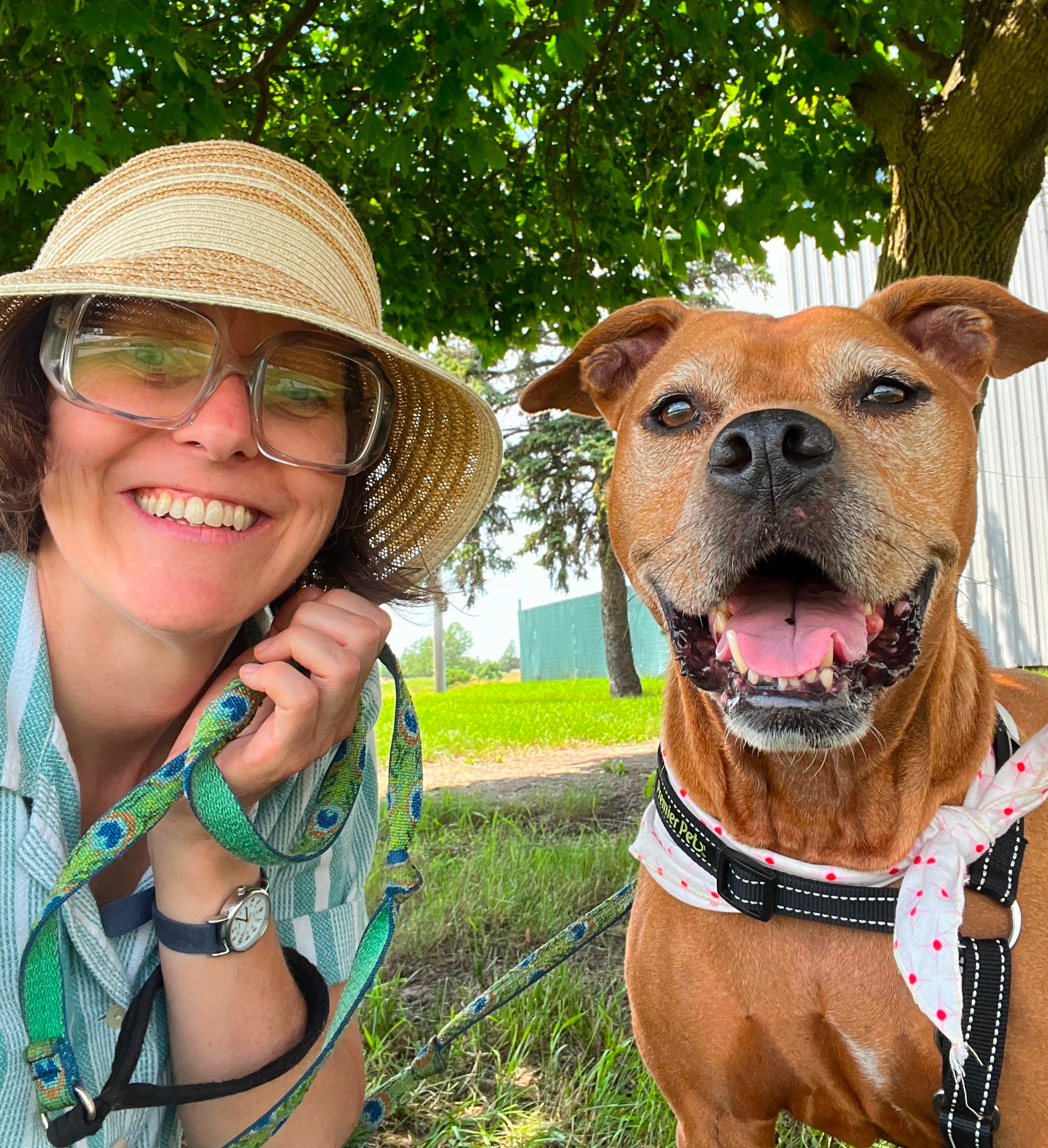
This is beautiful, Jo. Thank you for sharing sweet Ginge with all of us. It was the greatest of honors to be loved on by her, and I sure do hope when we all meet our maker we get to see all of our sweeties again. It sure makes the inevitable more peaceful to look forward to.
Oh Jodie, what a privilege to read and feel. I felt your turmoil as you weaved between your story and Ginger’s truth - a real reminder of us forgoing control and trusting that we don’t really have a say in the outcome of things. But we can try to make things more sweet and soft. Ginger had her own way and I can tell that any decisions you had to make were so guided by your deep need and desire to do what was best for her. Not because of control but out of compassion and respect. How can we ever return what our animal friends give to us? I too felt grief for others as I read. Thank you for sharing when it felt right. And thank you to Ginger for being such a bright light ✨